
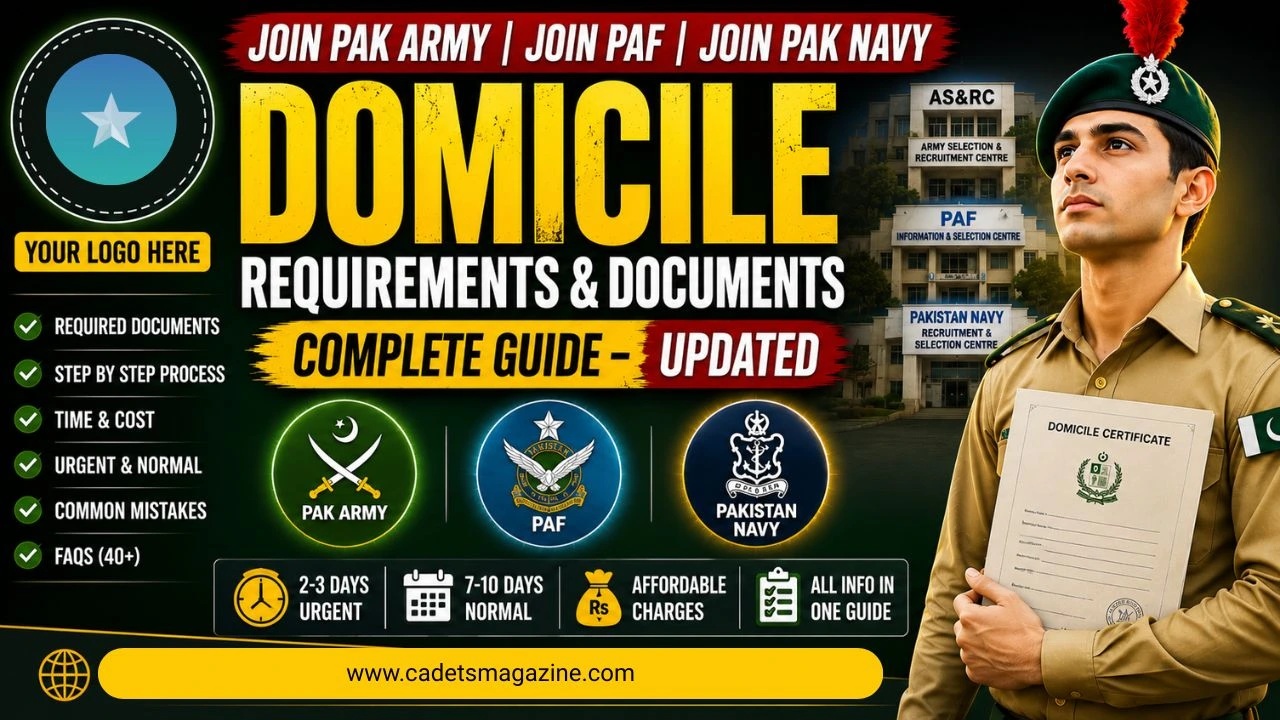


Domicile is one of the most important documents required during the Join Pak Army, Pakistan Air Force (PAF), and Pakistan Navy recruitment process. Every recruitment season, thousands of candidates search the same questions: Is domicile compulsory? How do I get a domicile certificate? Which documents are required? How much does it cost? How long does it take? Can I apply urgently? This complete guide answers all these questions in one place with a simple, step-by-step explanation to help you prepare before your initial test.
Many otherwise eligible candidates face unnecessary delays because they apply for their domicile too late or submit incomplete documents. In this guide, you’ll learn the easiest way to get a domicile certificate in Pakistan, the required documents, processing time, estimated fees, common mistakes to avoid, and everything you need before visiting an Army Selection and Recruitment Centre (AS&RC), Pakistan Air Force Information & Selection Centre (PAF I&SC), or Pakistan Navy Recruitment & Selection Centre.
Whether you’re preparing to Join Pak Army, Join PAF, or Join Pakistan Navy, this Cadets Magazine guide is designed to answer every major question about domicile requirements, helping you complete the process correctly and avoid last-minute problems before your document verification and initial recruitment test. Always verify the latest requirements with the official recruitment advertisement or your nearest recruitment center, as procedures may vary by province or district.
What Is Domicile in Pakistan?
A Domicile Certificate is an official government-issued document that proves the district and province you legally belong to in Pakistan. It is one of the most important documents required for Join Pak Army, Join PAF, Join Pakistan Navy, government jobs, university admissions, scholarships, and quota-based recruitment.
Unlike your CNIC, Form-B, or current residential address, a domicile certificate confirms your permanent regional affiliation. Government departments use it to verify your eligibility under provincial and district quota systems before completing recruitment or admission.
Why is a Domicile Certificate Important?
A domicile certificate helps government organizations determine which province and district quota you belong to. It ensures that recruitment and admissions are conducted fairly while maintaining representation from every region of Pakistan.
For candidates applying to Join Pak Army, Pakistan Air Force (PAF), or Pakistan Navy, a domicile certificate is one of the key documents required during document verification at recruitment centres. Without it, your verification process may be delayed if the recruitment notice requires it.
Is a Domicile Certificate Required for Join Pak Army, PAF & Pakistan Navy?
Yes, a domicile certificate is commonly included among the required documents during the recruitment process for the Pakistan Army, PAF, and Pakistan Navy, subject to the current recruitment advertisement. It confirms your provincial and district eligibility for quota-based recruitment.
To avoid last-minute issues, candidates should prepare their domicile certificate before reporting for document verification and always follow the latest instructions issued in the official recruitment notice.
Permanent Address vs Temporary Address vs CNIC Address vs Domicile
Many candidates think these terms mean the same thing, but each serves a different purpose. Understanding the difference can help you avoid document verification problems during recruitment.
| Address Type | Meaning |
|---|---|
| Permanent Address | Your family’s long-term or ancestral home where you permanently belong. |
| Temporary Address | Your current residence for studies, work, or any temporary stay. |
| CNIC Address | The address registered with NADRA on your Computerized National Identity Card (CNIC). It can be updated and does not determine your domicile. |
| Domicile Certificate | A government-issued certificate confirming your legal district and province for quota, recruitment, education, and public-sector purposes. |
Can My Domicile Be Different from My CNIC Address?
Yes. Your domicile certificate and CNIC address do not have to be the same. A candidate may study in one city, have a CNIC registered in another, and still legally hold a domicile certificate from their family’s permanent district.
This is why recruitment authorities ask for your domicile separately. Your CNIC identifies you, while your domicile identifies your official district and province for quota-based recruitment and admissions.
Why Is Domicile Required for Join Pak Army, PAF or Navy?
A domicile certificate is one of the most important documents commonly required during document verification for candidates applying to Join Pak Army, Join Pakistan Air Force (PAF), and Join Pakistan Navy. It helps recruitment authorities verify your district and provincial quota at Army Selection and Recruitment Centres (AS&RCs), PAF Information & Selection Centres (PAF I&SCs), and Pakistan Navy Recruitment & Selection Centres as part of the recruitment process. To avoid last-minute delays before your initial test, it is recommended to obtain your domicile well in advance and always verify the latest document requirements through the official recruitment advertisement, as requirements may vary by entry scheme or recruitment cycle.
Documents Required to Make Domicile in Pakistan
The exact document list can vary slightly by district and by individual circumstances (for example, whether the applicant is a minor, married, or applying based on a deceased parent’s record). The table below reflects the documents most commonly requested across Pakistan’s provinces.
| Document | Required | Notes |
| Father’s CNIC copy | Yes | Attested photocopy; original shown for verification |
| Mother’s CNIC copy | Yes | Requested in some districts or where father’s record is unavailable |
| Candidate’s CNIC OR Form-B | Yes | Form-B accepted for applicants under 18 |
| Passport-size photographs | Yes | Usually 2–3, white background, recent |
| Electricity bill | Yes | Recent bill in family’s name; most widely accepted proof of residence |
| Educational result card | Yes | Latest relevant qualification; requirements vary by district |
| Mobile number | Yes | Required for OTP verification and SMS tracking updates (Use SIM Registered on the ID Cards of Your Parents) |
| Guardian presence | Yes, for minors | Parent/guardian must generally appear in person |
| Guardian signature | Yes | Required on the application form |
| Guardian thumb impression | Yes | Taken at the facilitation counter along with photograph |
Note: Some districts also request an affidavit on stamp paper attested by an Oath Commissioner, though several areas have waived this requirement in recent years. Always confirm the current requirement list with your local e-Khidmat Markaz, DC office, or district court facilitation counter before your visit.
Step-by-Step Procedure to Get a Domicile Certificate in Pakistan (Easiest Method)
For most candidates, the easiest way to apply for a domicile certificate is through a local document facilitation center or a photocopy/document service shop that offers domicile application services in your area. These centers help prepare and submit your application, making the process much quicker and easier.
Step 1: Collect the Required Documents
Before visiting the service center, prepare all the required documents as above in table, including your CNIC or Form-B, father’s and mother’s CNIC copies, any educational result card (Matric, 9th, 10th, 1st Year, or above), a recent electricity bill (preferred), and 2–3 passport-size photographs with a white or blue background.
Step 2: Visit a Local Domicile Facilitation Centre
Visit a nearby document facilitation centre or service provider that offers domicile application services in your district. The staff will review your documents, prepare the application, and guide you through the submission process.
Step 3: Submit Your Documents
Hand over the required document copies to the operator. Your original result card and Form-B/CNIC are usually checked for verification and returned to you, while the required photocopies are attached to your application.
Step 4: Guardian Verification
Your mother or father may be asked to accompany you for verification. They may need to sign the application register and provide a thumb impression as part of the verification process, depending on your district’s requirements.
Step 5: Mobile Number & OTP Verification
Provide an active mobile number registered with your family. During the application process, you may receive one or more OTP (One-Time Password) verification codes, which must be confirmed to complete the application.
Step 6: Choose Normal or Urgent Processing
Most districts offer Normal and Urgent processing options. Normal applications generally take 7–10 working days, while urgent applications may be completed in 2–3 working days, depending on local procedures and workload.
| Type | Typical Timeframe | Notes |
| Normal processing | Around 7–15 working days | Most common track; timing depends on district workload |
| Urgent/expedited processing | Around 2–5 working days | Not offered by every district; may cost more; confirm availability locally |
Step 7: Pay the Service Charges
Pay the applicable processing or service charges. In many areas, applicants typically pay around PKR 2,000–3,000, although the total cost may vary depending on the district, service provider, and whether you choose normal or urgent processing.
Step 8: Collect Your Domicile Certificate
Once your application is processed, the service provider or relevant office will notify you. Collect your original domicile certificate and keep several photocopies ready for Join Pak Army, Join PAF, Join Pakistan Navy, university admissions, and other government applications.
💡 Cadets Magazine Tip:
Don’t wait until Join Pak Army, PAF, or Pakistan Navy registration opens. Apply for your domicile certificate several weeks in advance so you have enough time to complete document verification without unnecessary delays.
Common Mistakes Candidates Make
Most domicile delays are avoidable. Here are the mistakes we see most often among Army, Navy, and PAF aspirants:
- Wrong utility bill: Submitting a bill that isn’t in the family’s registered name, or one that’s too old to be accepted.
- Old photographs: Using outdated passport photos that don’t match current appearance or don’t meet the white-background requirement.
- Wrong CNIC copies: Submitting unattested or poor-quality photocopies that are hard to read.
- Missing guardian: Minors arriving without a parent or legal guardian present, causing an automatic rejection at the counter.
- Wrong phone number: Registering a mobile number that isn’t accessible for OTP verification, causing the application to stall.
- OTP issues: Not having the phone on hand, or the SIM being registered to someone else entirely.
- Damaged documents: Torn, faded, or water-damaged CNICs and certificates that can’t be clearly verified.
- Unreadable copies: Photocopies that are too dark, too light, or cropped, forcing a second visit.
- Different addresses: Panicking over a mismatch between CNIC address and domicile district, when in most cases this is normal and expected.
- Waiting until Army registration opens: By far the costliest mistake — starting the domicile process only after seeing a recruitment advertisement, when queues are longest and timelines are least predictable.
The single biggest lesson from this list: domicile is not something to rush at the last minute. Start early, and most of these mistakes simply won’t apply to you.
Checklist Before Visiting the Recruitment Centre
Whether you’re headed to an Army Selection & Recruitment Centre (AS&RC), a PAF Information & Selection Centre (PAF I&SC), or a Pakistan Navy Recruitment & Selection Centre, run through this quick checklist first:
- Original domicile certificate, OR at least two attested photocopies
- Original CNIC or Form-B, plus attested photocopies
- Father’s/guardian’s CNIC copy
- Latest educational result card (original + copies)
- Required number of recent passport-size photographs
- Character certificate, if required by your specific entry scheme
- Application form/roll number slip printed and signed
- Prospectus fee (if applicable) in the correct amount
- A folder or file to keep all documents organized and undamaged
Domicile Required Documents Checklist
Use this as a simple tick-list while preparing your domicile application itself:
✅ Candidate’s CNIC or Form-B
✅ Father’s CNIC copy (attested)
✅ Mother’s CNIC copy (if applicable/requested)
✅ 2–3 recent passport-size photographs (white background)
✅ Recent electricity bill in family’s name
✅ Latest educational result card
✅ Working mobile number for OTP
✅ Guardian available in person (for minors)
✅ Payment/Charges (Applicable at Time)
✅ Affidavit on stamp paper, if required in your district (Usually Photocopier Makes it)
Frequently Asked Questions
Is domicile certificate compulsory for Pak Army, PAF, and Pakistan Navy?
Yes, domicile is generally required during the document verification process for Pakistan Army, Pakistan Air Force, and Pakistan Navy recruitment. Candidates should always check the latest recruitment advertisement because requirements may vary by entry type.
Can I apply for domicile before turning 18 in Pakistan?
Yes, minors can apply for a domicile certificate using their Form-B along with their father’s or guardian’s CNIC. A parent or legal guardian is usually required to appear for verification.
Can Form-B be used instead of CNIC for domicile?
Yes, candidates under 18 years of age can generally use NADRA Form-B (Child Registration Certificate) instead of CNIC for domicile applications and recruitment document verification.
How long does it take to get a domicile certificate in Pakistan?
The processing time depends on the district and workload. Normally, a domicile certificate may take around 7 to 15 working days, while urgent processing (where available) can be faster.
Can domicile address be different from CNIC address?
Yes, a domicile address can be different from the CNIC address. Domicile is usually based on ancestral residence, family records, or permanent district connection rather than only the address written on CNIC.
Can I apply for domicile online in Pakistan?
Yes, some provinces such as Punjab provide online facilities through government portals and e-Khidmat Markaz. However, document verification or physical appearance may still be required depending on the district.
What happens if my domicile is not ready before Army recruitment?
If your domicile is still under process, contact your nearest Army Selection & Recruitment Centre (AS&RC), PAF Information & Selection Centre, or Navy recruitment centre before your test date. Do not assume that an application receipt will always be accepted.

One Response
That was the most easy and best process to get my domicile. Thank you